
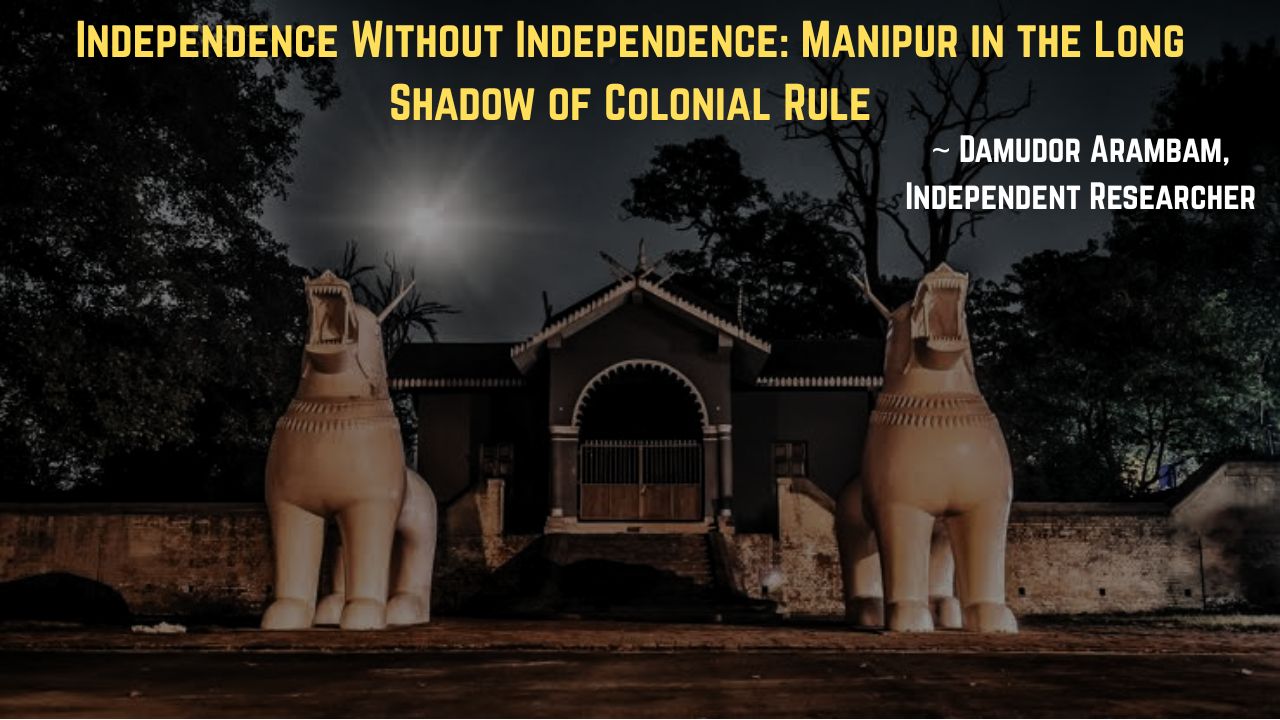
Independence Without Independence: Manipur in the Long Shadow of Colonial Rule
Written by Damudor Arambam
The political condition of Manipur today lays bare an uncomfortable truth: beneath the surface of electoral rituals and the performance of federalism, the state operates as if it were still under colonial rule. Despite the BJP commanding both the Centre and the state, power flows in one direction only, with Delhi remaining the sovereign. The state government functions as little more than a transmission belt, and non-state actors, insurgents included, orbit within the limits prescribed by Delhi. President’s Rule has only made this arrangement more visible. What is remarkable is not the imposition of central rule but the ease with which it has been accepted, even welcomed. The Indian state’s ability to present the suspension of the rule of law as stability is no accident; it is the result of decades of colonial governmentality that has disciplined both rulers and the ruled into mistaking domination for normalcy.
The irony becomes glaring every August. The same public that invokes the memory of resisting British imperialism celebrates Manipur’s supposed Independence Day and then, within days, celebrates India’s Independence Day. This is not hypocrisy but pedagogy. Colonial power always relied on ritual and spectacle to legitimise domination. In Manipur, commemorations of independence, whether on 14 August or 15 August, do not mark freedom but obscure its absence. Independence, if it is real, cannot be confined to a date on the calendar. It must be lived in the everyday, in the autonomy to shape political and cultural life. To argue endlessly over which day deserves recognition is to avoid the harder question: why has independence, in any substantive sense, never been experienced?
This is precisely where Manipur’s anti-colonial writers and intellectuals have failed. By fixating on the annexation of 1949 as the singular moment of lost sovereignty, they reduce coloniality to a question of juridical legitimacy. Was the merger agreement valid? Was consent manufactured? Did the princely state retain sovereignty until the moment of annexation? These are important historical questions, but they cannot exhaust the political problem. To locate the entire loss of freedom in one constitutional moment is to narrow coloniality to the courtroom. The effect is to romanticise the pre-merger monarchy as a sovereign polity, as if the masses under a feudal order were truly free. This fixation blinds us to the deeper continuity: the apparatus of rule, bureaucratic and coercive, has remained colonial in form and function from then until now.
What further complicates this ritualisation of independence is the way in which the framing of Manipur’s Constitution in 1947 is invoked. Written hurriedly, in the short gap between the British withdrawal and the consolidation of the Indian Republic, it was less a genuine social contract than a document shaped under the shadow of a departing empire and a rising nation-state. Across British India, such hurried constitutional experiments were permitted in the princely states not to enable autonomy but to pre-empt and manage popular demands, to exert certain claims of legitimacy before the Indian Constitution subsumed them. Manipur’s own Constitution was part of this logic: the grant of a skeletal parliamentary structure to signal sovereignty, while real sovereignty was already being foreclosed. Yet today, this truncated episode is often glorified through ritual, as though the mere existence of a Constitution signified genuine independence. To celebrate such fragments without interrogating the conditions of their production is to mistake form for substance and to obscure the colonial continuity that structured them.
Partha Chatterjee once remarked that postcolonial nations often reproduce the logics of colonial rule within their own borders, governing populations as objects rather than subjects. Manipur today is an illustration of this condition. The Centre governs not by empowering a federal partner but by managing a frontier territory. Political actors, whether insurgents negotiating ceasefires, civil society bodies issuing statements, or elected representatives awaiting clearance from Delhi, operate within rules not of their making. The frontier is not autonomous; it is administered. Yet anti-colonial scholarship in the state, trapped in the obsession with 1949, rarely interrogates this present condition. It is content to argue the legality of annexation while Delhi governs uninterrupted.
Indeed, the absence of a serious class analysis in Manipur’s revolutionary traditions has been decisive. The long movements of resistance in the Northeast, while radical in aspiration, rarely cultivated class consciousness as their organising principle. Instead, they devolved into fragmented ethnonationalisms, each asserting autonomy in the name of community while neglecting the shared material conditions of the working poor. Gramsci’s theory of hegemony clarifies this failure: without building a counter-hegemonic bloc grounded in class solidarity, insurgency became vulnerable to co-optation and fragmentation. In the absence of a class politics, ethnonationalism became the dominant grammar of resistance, reproducing divisions that the state could easily manipulate. What could have been revolutionary universalism hardened into particularism, leaving the masses with symbols of sovereignty but without the substance of liberation.
Achille Mbembe’s idea of the “colonial state of exception” resonates here. Manipur has long been governed as a permanent exception, where the suspension of ordinary politics is treated as natural. AFSPA is the most visible manifestation, but even beyond that law, the very possibility of self-rule is perpetually deferred. President’s Rule becomes just another episode in a long series of interruptions, and the people adjust to it as though it were routine. The tragedy is that what should provoke resistance has become normalised, even banal.
What is needed is a reckoning with the colonial inheritance of the postcolonial state. The bureaucratic apparatus that governs Manipur today is not neutral; it is the institutional residue of colonial power, perfected in its ability to centralise, discipline, and manage difference. It cannot afford to remain trapped in the juridical fetish of 1949, as if undoing a signature would undo the colonial state. Nor can it cling to nostalgia for a feudal past, mistaking monarchy for sovereignty. Anti-colonial scholarship must therefore move beyond the juridical dispute of annexation and confront the continuities of colonial governmentality that structure the present. It must also confront its own failures: the refusal to engage with class struggle, and internal hierarchies, the romanticisation of sovereignty without social transformation. Without such confrontation, “anti-colonial” discourse risks becoming an alibi for reproducing new forms of elite domination under the guise of resistance.
This is why celebrating independence days in Manipur, be it of India or Manipur, is not merely hollow but complicit. It is to participate in the ritualisation of subjection. The very act of choosing dates, 14 August for one imagined sovereignty, 15 August for another, keeps the debate trapped in the symbolic, while the actual colonial condition goes unchallenged. Independence becomes a matter of calendars rather than conditions. The flags are raised, the speeches made, but the people remain governed from elsewhere.
Independence is not about a day. It is about dismantling the structures of domination that render days necessary. Manipur today does not need another date on the calendar to commemorate; it needs to confront the truth that independence, in the material sense of the word, has never been realised. Until that confrontation occurs, the so-called independence celebrations, whether of India or Manipur, will continue to be little more than ceremonies in the long shadow of colonial rule.
(The author is an independent researcher and can be reached at damudor.arambam@gmail.com)
* The views expressed in this article are those of the author and do not necessarily reflect the views of us.