
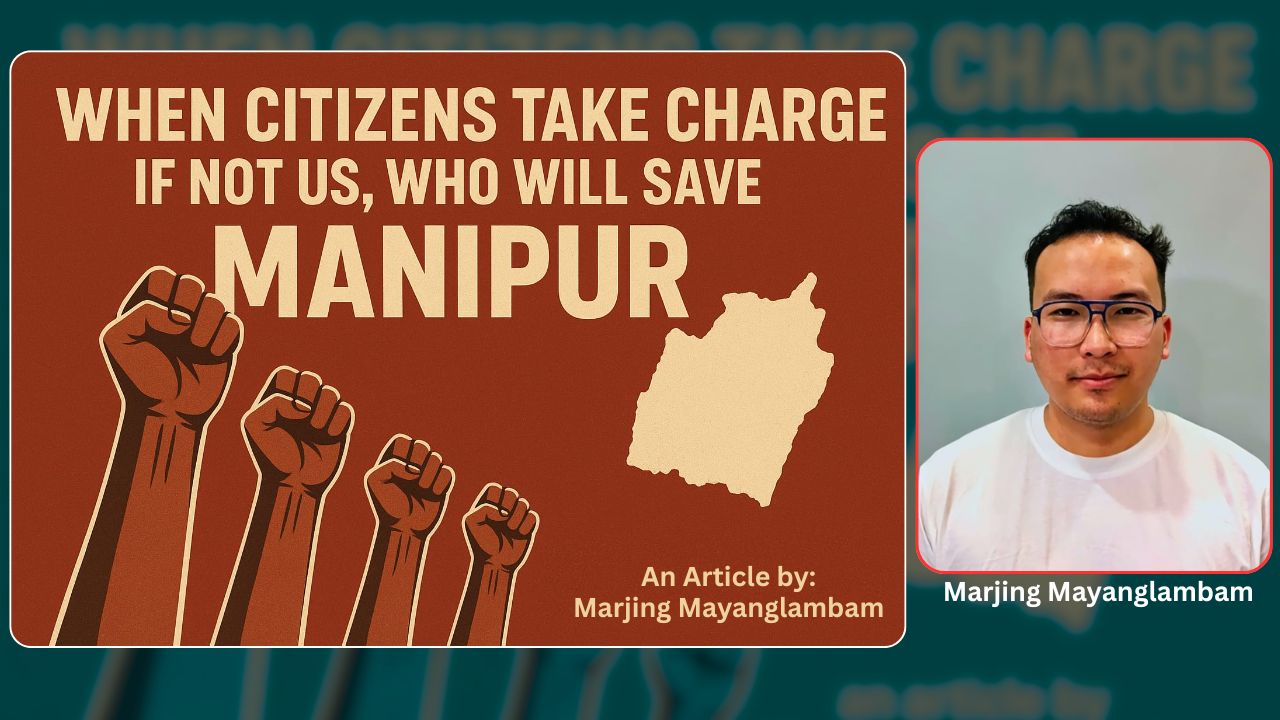
When Citizens Take Charge: If Not Us, Who Will Save Manipur
Written by Marjing Mayanglambam
We, the people, need to reform. We, the citizens, need to change our society, our land, our home, by ourselves. We cannot simply wait for the government to do its duty. Yes, our hard-earned money pays their salaries, but for now, we have no choice but to take matters into our own hands. That said, we must continue to pressure officials to serve us properly and fulfil their responsibilities. Change will not come from empty promises or ceremonial events. It will come from citizens who care enough to act, to demand, and to participate actively in shaping their community.
It is ironic, almost laughable, to see government social media handles flaunting developmental plans, MoUs, and schemes while in reality, we struggle to access basic amenities like pothole-free roads. We are told of grand visions for economic development, infrastructure, and social welfare, yet the reality on the ground remains starkly different. Vocal politicians and high-ranking bureaucrats may deliver eloquent speeches and slam podiums with dramatic effect, but action speaks louder than words. We need tangible steps that lead to real development, not mere political theatrics or superficial social media updates that give the illusion of progress.
If a car does not ignite, we check its engine. Similarly, we must examine the “engine” or “double engine” of our government. We must dissect what is working, what is failing, and what requires immediate attention. Citizens have democratic tools at their disposal—Right to Information applications, Public Interest Litigations, petitions, and peaceful protests—that can compel authorities to act. Using these tools is not an act of rebellion. It is a rightful demand for the benefits guaranteed to every Indian citizen. By holding the government accountable, we push it toward efficiency, transparency, and responsibility.
But legal tools alone are not sufficient. Action requires awareness, coordination, and unity among the people themselves. This is where the citizens of Manipur must step forward decisively. We must unite, regardless of clan, community, tribe, or ideology. We may have different political beliefs, different priorities, and even conflicting interests, but when it comes to protecting and developing our land, these differences must be set aside.
We must abandon the “Waikhu Culture,” the tendency to drag one another down like crabs in a bucket. Goondaism, exploitation, jealousy, and internal divisions only hinder progress. They allow outsiders and vested interests to exploit our land’s resources and strategic location for their own gain. If we cannot collaborate and support one another, our land, our culture, and our identity will continue to be at risk. It is high timethat we realise that the responsibility to protect and develop Manipur rests primarily on our shoulders. If not us, who will safeguard it?
True, uniting is not easy. Our society has been fragmented for generations, and the wounds of internal conflicts run deep. Yet it is never too late to come together for a higher purpose. Is it not shameful to see fellow Manipuris living as refugees in their own homeland? Is it not disheartening to witness outsiders wreaking havoc on our land while we remain divided? Each day we hesitate, opportunities for growth, development, and protection slip away. By standing together, we demonstrate the collective strength that can demand accountability, implement solutions, and foster progress.
Furthermore, we must not ignore the importance of practical action in everyday life. Civic responsibility is not merely a concept for debate. It is a daily practice. It means cleaning public spaces, reporting issues promptly, supporting community initiatives, and nurturing a culture of mutual respect and cooperation. Change cannot only exist on paper. It must be reflected in our streets, schools, marketplaces, and neighbourhoods. Each citizen’s contribution adds up to a larger force capable of shaping a more functional, fair, and prosperous society.
Ultimately, the government is like a child. If it does not listen, it must be guided and sometimes reminded through legitimate, lawful means. But as citizens, we must be equipped with the right knowledge, tools, and awareness to hold it accountable. Questioning authorities is not a sign of disrespect. It is the duty of every responsible citizen. A government that is not answerable to its people is a threat to the democratic principles we hold dear. We must ensure that accountability, transparency, and integrity are not just buzzwords but guiding principles that govern every level of administration.
We must also abandon petty pride and selfish interests that weaken collective efforts. We cannot allow internal rivalries, personal grudges, or the lust for wealth to undermine the progress of our land. Material gains are fleeting and cannot accompany us beyond this life, but our actions today can secure the future of Manipur for generations to come. It is not enough to lament. We must act. It is not enough to demand. We must organise. And it is not enough to hope. We must implement.
If not you, if not I, then who will save Manipur? The answer lies in each of us stepping forward, uniting, and taking responsibility. Every concerned citizen, every youth, every elder, every individual willing to act responsibly has a role to play. Together, our collective strength can drive change, demand accountability, and build a society that reflects the values, dignity, and aspirations of its people. Change will not come from a distant authority. It will come from the people themselves.
So, let us rise, let us unite, and let us act. Let us be the citizens who refuse to settle for empty promises, superficial social media updates, or political theatrics. Let usbe the citizens who ensure that Manipur thrives, not only as a land of cultural richness and natural beauty but as a society governed by responsibility, accountability, and collective action. The time for waiting is over. The time for united action is now.
(Marjing Mayanglambam is currently pursuing M.A. in Folklore & Culture Studies. He is a Pena Artiste & Researcher at Laihui Ensemble.The author can be reached at marjingmmm@gmail.com)