
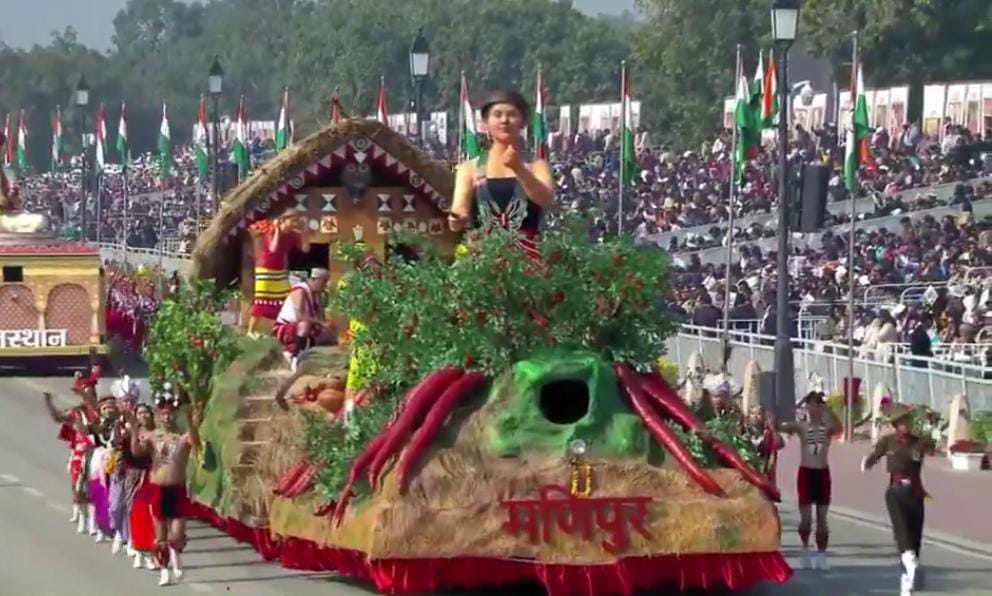
Republic Day: Manipur Tableau Showcases Chak-Hao, Hathei Chilli, Tamenglong Orange
The Manipur tableau showcased the state’s inspiring journey of turning indigenous, high-value agricultural products from cultural symbols into powerful engines of economic growth. The display highlighted how Geographical Indication (GI)–tagged products are expanding access to national and international markets while improving the livelihoods of thousands of farmers across the state.
At the forefront of the tableau, the renowned Sirarakhong Hathei Chilli from the Ukhrul hills was prominently featured. A woman dressed in traditional attire was depicted harvesting the crop, symbolising grassroots empowerment and the growing role of women in agriculture. The GI tag emblem was displayed to represent authenticity, legal protection, and global recognition of Manipur’s unique produce.
The central portion of the tableau illustrated the traditional threshing and winnowing of Chak-Hao, Manipur’s famous black rice known for its rich aroma and nutritional value. With rising demand in countries such as Japan, South Korea, China, and the European Union through APEDA-supported initiatives, Chak-Hao was presented as a key example of value-added exports and farmer self-reliance.
At the rear, the tableau highlighted the celebrated Tamenglong Orange, set against the backdrop of a traditional Taraeng-Kai house from Manipur’s western hills. The inclusion of the ‘Organic India’ logo reflected organic certification across more than 400 hectares under the National Programme for Organic Production (NPOP), reinforcing the state’s vision of becoming a fully organic region.
The side panels of the tableau featured artistic relief depictions of the Nong-in (Bar-tailed or Mrs. Hume’s Pheasant), the state bird, adding cultural and ecological significance to the presentation.
Adding to the cultural grandeur of the Republic Day celebrations, a 50-member troupe from the Jawaharlal Nehru Manipur Dance Academy (JNMDA) performed traditional Manipuri dance forms at the national event. The artists showcased the state’s classical and folk dance heritage, further highlighting Manipur’s rich cultural legacy before a national and international audience.
Overall, the Manipur tableau stood as a vibrant representation of the state’s agricultural innovation, cultural heritage, women’s empowerment, and commitment to sustainable and organic development on the national stage.