
Statehood Movement in Manipur and Meitei Pangals
Written by Dr. Syed Ahmed (Associate Professor, Department of History,Dhanamanjuri University,Imphal)
On January 21, three northeastern states, namely Tripura, Meghalaya and Manipur observed their 53rd Statehood Day marking the attainment of statehood in 1972 under North Eastern Areas (Reorganization) Act of 1971. In Manipur too, the State Government observed the day, but some political parties and organizations had questioned the relevance of observing Statehood Day at a time when the State is in a state of turmoil.
The statehood of Manipur was not attained easily. It was achieved after a long and intense struggle which is worth re-telling. Manipur became a Part-C State with a Chief Commissioner (later a Lieutenant Governor) as the administrative head. All the executive and legislative powers were vested in him under the order from the President of India. A 14-member Advisory Council was constituted and the members were nominated by the Government of India on the proposal of the Chief Commissioner. Md. Alimuddin (he had represented the first Manipur Legislative Assembly, 1948-49, from Lilong constituency and served as the Minister for Jail, Medical, Public Health and Sanitation departments) was nominated as a member of Praja Shanti Party in the Advisory Council, with Maj. Gen. Rawal Amar Singh as the Chairman (Oct. 15, 1949 to Oct. 18, 1949).
The political arrangement was not warmly received by the Manipuris. A demand for statehood soon emerged. To pacify the situation, the Centre upgraded Manipur from a Part-C State to a Union Territory on Nov. 1, 1956 under the Union Territorial Council Act, 1956. A Territorial Council with 30 elected and 2 nominated members was constituted.
The step was not up to the satisfaction of the people of Manipur. The demand for statehood intensified in the late 1960s. The political parties and several civil society organizations in Manipur joined hands to make it a mass movement. On Feb. 29, 1968, a massive body, All Manipur Statehood Demand Committee, was constituted at the initiative of few political parties in the state. On Mar. 30-31, the committee organised a massive political conference at Aryan Theatre Hall, Imphal, and urged the Centre to grant statehood to Manipur at the earliest. The committee further organised several public meetings, demonstrations and bandhs. The committee also demanded inclusion of Manipuri in the 8th Schedule of the Indian Constitution and setting up of a University in the state.
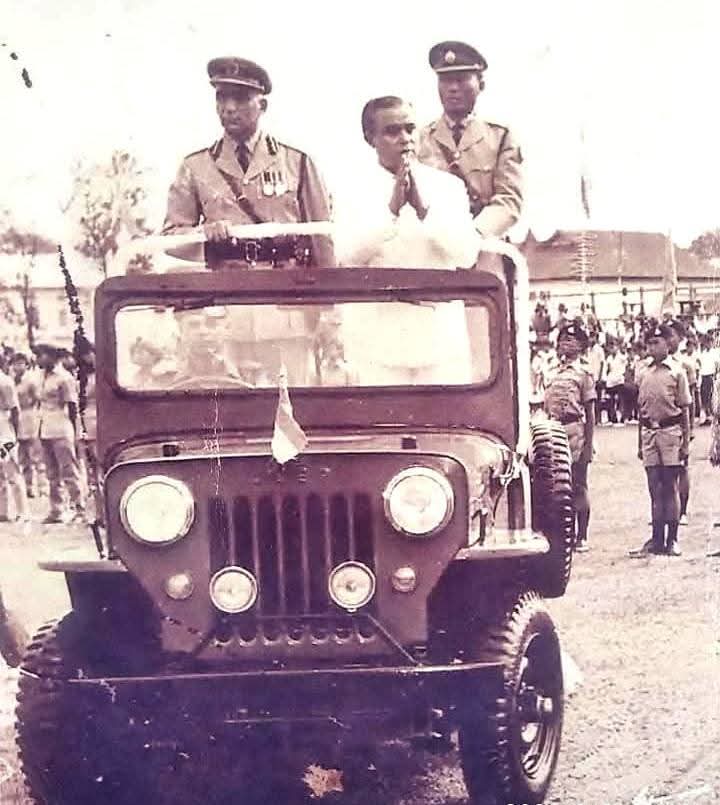
On Sept. 23, 1969, Prime Minister Mrs. Indira Gandhi (1966 – Mar. 1977) paid her first visit to Manipur. State Congress organized a public meeting at Imphal Pologround or Mapal Kangjeibung. Students barged in the ground shouting slogan demanding statehood. Police lathi charged to control the situation, while crowd reacted by throwing stones. In the mayhem, numerous government and private vehicles were torched. Curfew was imposed and army was deployed to bring law and order. Prime Minister returned the following day knowing the mood of the people against the Centre for not granting statehood.
Further, on Apr. 26, 1970, an All Parties Statehood Demand Co-ordinating Body was also floated as a political platform to struggle for the statehood. The body organized a reception at Imphal on May 9, 1970 and welcomed the visit of nine MPs of various political parties to Manipur in connection with the statehood issue. The co-ordinating body submitted a memorandum demanding statehood for Manipur. Later, a delegation went to went to Delhi and met opposition leaders and Prime Minister, Mrs. Indira Gandhi. The Committee also organized a bandh on May 18, 1970, and passed resolutions that included demand for resignation of MPs, elected members of Imphal Municipal Board, boycott of all official functions of state government and elections, etc. It was followed by Civil Disobedience Movement. Demonstrators stormed the state secretariat and Lt. Governors office. Law and order situation worsened. On Aug. 17, 1970, volunteers of the All Parties Statehood Demand Co-ordinating Body observed satyagraha near the Secretariat gates shouting slogans. All of them were arrested and put in jail. Eventually, on Sept. 3, 1970, the Prime Minister announced the approval of the demand of the statehood to Manipur. North Eastern Areas (Reorganization) Act, 1971 was passed by the Parliament. Under the Act, Manipur, Meghalaya and Tripura attained statehood. Mrs. Indira Gandhi visited Imphal and inaugurated Manipur as a full fledged state on Jan. 21, 1972.
Under the provisions of the Act, the office of Governor was instituted as the Constitutional head in Manipur, besides establishing a Legislative Assembly with 60 members. B.K. Nehru, the then Governor of Assam and other states, was sworn as the Governor of Manipur (Jan. 21, 1972 – Sept. 20, 1973)
Several Meitei Pangals were involved in the statehood movement. In fact, almost all the Meitei Pangal, who were elected to the Manipur State Assembly in the Assembly Election of 1972 were leaders of the statehood movement. Many of them went to jail.
Dr. Md. Abdul Salam (in an article, The Role of Muslims in the statehood movement in Manipur published in Journal of Humanities & Social Science, Oct. 2017) writes:
“On 17th August 1970, volunteers of the All Parties Statehood Demand Co-ordinating Body observed Satyagraha near Secretariat gates with slogan like, we demand statehood, Co-ordination Body Zindabad were shouted. All of them were arrested and put into jail. The then leaders of the Muslim Md. Alimuddin, Md. Ashraf Ali, Md. Chaoba, Md. Alauddin, Md. Abdul Wahid along with large numbers of other Muslims, namely Md. Feijuddin, Md. Alauddin, Md. Najir Ahmed, Md. Basiruddin, Md. Siraj Ahmed, Md. Alauddin, Md. Amuba, Md. Maniruddin, etc. were arrested by the police. As the Central Jail at Imphal did not have sufficient accommodation for confining the agitator a temporary sub-jail was established at Pallel. The law and order situated completely collapsed. The administrative machinery was totally paralyzed. The people refused to give any co-operation to the administration. Thus a serious situation was developing in the state. The matter became of very serious concern to the ruling party in the centre.” (Based on an interview with Md. Feijuddin of Lilong Ubakthong on Apr. 20, 2017)

There is also the famous episode of Mrs. Indira Gandhi being rescued from the crowd at Mapal Kangjeibung by Ahmedullah Mirza from Hafiz Hatta and Yangmaso Saiza during her visit to Manipur in 1969. Mirza was later invited by Mrs. Indira Gandhi at her official residence in Delhi. He served as the Private Secretary of Yangmaso Saiza when he became the Chief Minister (Jul. 10, 1974 – Dec. 5, 1974 / Jun. 25, 1977 – Nov. 13, 1979). Mirza later entered active politics. He contested the Assembly Election of 1980 and 1984 in Wangkhei Constituency. In 1989 election he contested as INC (I) candidate, but lost to Y. Erabot Singh, JP candidate by a margin of 1,145 votes, in the election of 1984, Mirza contested as an Independent Candidate, but again lost to Erabot Singh, an INC candidate by a margin of 1,302 votes.
It may be mentioned that during the course of the intense agitation for statehood, a group of Congress defectors, led by Salam Tombi Singh, Yumnam Yaima and Khwairakpam Chaoba initiated to form a regional political party. It was soon joined by seven Congress leaders, namely Md. Alimuddin, Md. Chaoba, S. Gambhir Singh, Ch. Rajmohon Singh, S. Lorho, L. Thambou Singh and Md. Ashraf Ali. The party, christened as Manipur People’s Party (MPP), was formally launched at a convention held on Dec. 26, 1968. Notably, Salam Tombi named the party taking the example of Zulfikar Ali Bhutto’s Pakistan People’s Party, formed in 1967. The party entered the electoral politics in 1972 and emerged as a powerful political force which eventually formed government in the state.
The first Assembly election was held subsequently after Manipur got its statehood in 1972 with great enthusiasm and expectations. The Governor, B.K. Nehru, issued a notification on Feb. 1, 1973 for the general election to constitute a new Legislative Assembly for the state. The delimitation of the constituencies was done hastily to hold the election in Manipur along with other states where it was due. The number of constituencies was increased to 60 (39 seats for generals, 20 seats reserved for STs and 1 seat for SCs). Accordingly, elaborate arrangements were made for the election.
An intense election campaigning was commenced. MPP and Congress emerged as the strongest contenders. It would be pertinent to briefly look at the election manifestoes of the two political parties. MPP prepared an impressive manifesto that included: fixing the urban property ceiling at a maximum of Rs. 4 lakhs, amendment of the Land Reform Act, giving employment by setting up of factories, such as cement factor, paper mill, sugar mill, tasar factory, electronic industry, watch factory, etc. and to take over Loktak project as a state project, shifting of 4th Assam Rifles from Kangla, eradication of corruption, introduction of double cropping system, rural electrification, providing drinking water, housing scheme, setting up of a university, medical, engineering, agricultural colleges and a central research institute, setting up of pay commission, separate high court and governor for Manipur, free education up to high school level, etc. The manifesto of Congress included: developing handloom industry, setting up of paper mill and cement factory, spinning mill, tea gardens, and small scale industries such as cycle factory, watch factory, and factories for machine tools, fruit preservation and sugar, introduction of double cropping, setting up of a medical college, a university, rural electrification, town planning, inclusion of Manipuri language in the 8th schedule, etc.
MPP managed to receive wide popularity as it was rooted in regional aspirations and grievances. The party offered hope for a new and vibrant Manipur. The manifesto, as discussed, gave the vision of “Awonba Manipur.” On the other hand, Congress persistently emphasized in their election campaigns their struggle for statehood and the positive outcome.
The party-wise election result shows: MPP-15, CPI-5, INC-17, NCO-1, SOP-3, and IND-19. The results shocked INC as the party had expected absolute majority as the credit of granting statehood to Manipur goes to their party at the centre. The following five Muslims were elected:
Md. Jalaluddin (MPP) was elected from Keirao constituency by securing 3,964 votes, while his nearest rival P. Muhol Singh (INC) garnered 2,449 votes.
Md. Abdul Latif (IND) was elected from Mayang Imphal constituency by securing 2,391, while his nearest rival Khaidem Gulamjat Singh (MPP) got 2,054 votes.
Md. Alimuddin (MPP) was elected from Lilong constituency by securing 4,456 votes, while his closest rival Abdul Gani (INC) got 3,289 votes.
Md. Habibur Rahman (INC) was elected from Khekman constituency getting 3,790, while his nearest rival Thoudam Krishna (MPP) got 3,779 votes.
Md. Chaoba (MPP) was elected from Athokpam constituency by securing 2,055 votes, while his closest rival Sorokhaibam Chourjit (IND) got 2,034 votes.

MPP formed a coalition, named United Legislature Party (ULP), consisting of SSP, Cong-(O), and Independents. The Front had 37 MLAs out of 60. An MPP-led Government was formed with Md. Alimuddin as the Chief Minister of Manipur (Mar. 20, 1972 to Mar. 28, 1973). He was sworn in by Governor, B.K. Nehru, on Mar. 23, 1972.