
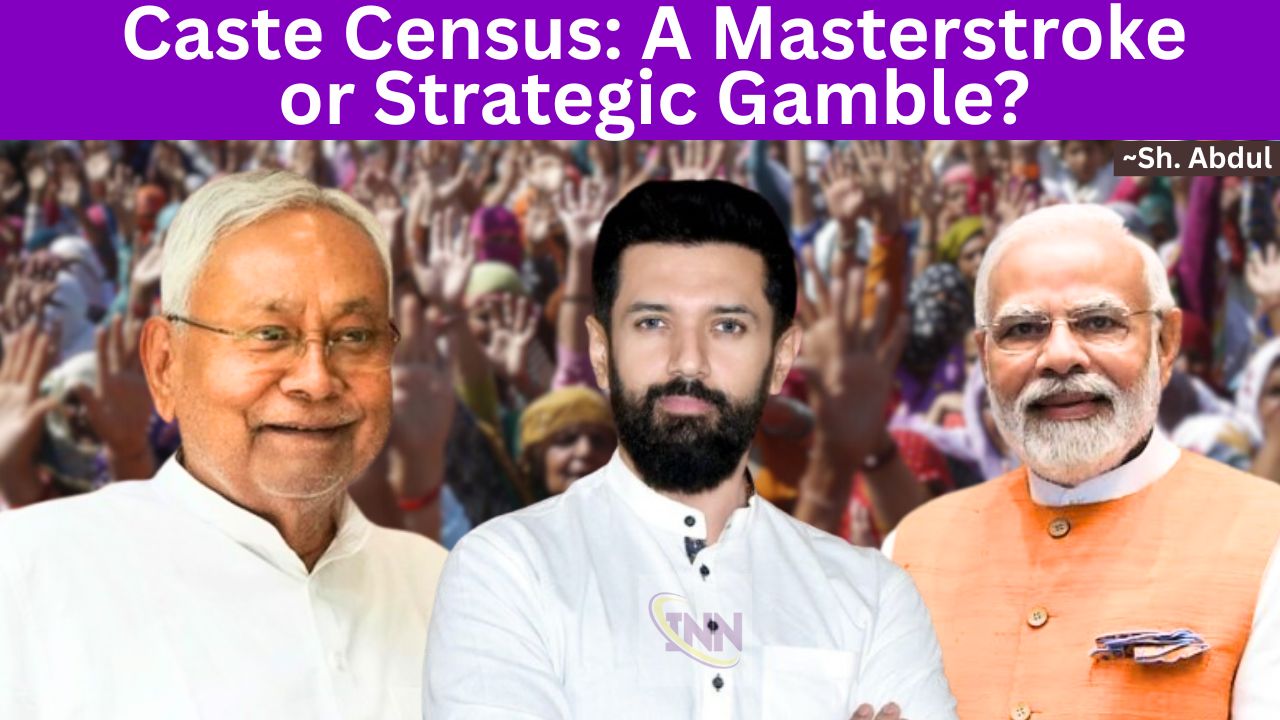
Caste Census: A Masterstroke or Strategic Gamble?
~Sh. Abdul
In a move that sent ripples through political circles and surprised analysts alike, Prime Minister Narendra Modi-led Cabinet Committee on Political Affairs (CCPA) announced a nationwide caste census in its meeting on April 30, 2025. This unexpected decision came immediately following a rare late-night meeting at the Prime Minister’s residence, 7 Lok Kalyan Marg, attended by RSS chief Mohan Bhagwat and Home Minister Amit Shah—figures who typically symbolize ideological coherence within the BJP-RSS framework, highlighting the significance of their collective decision at such a critical juncture.
The timing of this announcement was especially startling given the nation’s anticipation of the government’s response to the devastating terrorist attack in Pahalgam, Kashmir, claiming 26 Indian lives. Amidst a national security crisis, choosing this precise moment for an announcement of a caste census—an idea vehemently opposed by Modi himself in the past and consistently championed by the Leader of Opposition Rahul Gandhi—has sparked intense speculation.
Rahul Gandhi has consistently pledged to enact a caste census during the current parliamentary term, directly challenging the BJP’s electoral narrative of national unity symbolized by slogans such as “Ek hai toh safe hai” and “Batega toh katega.” Gandhi’s stance on caste census has found resonance among marginalized communities who feel underrepresented and underserved, potentially shifting electoral loyalties significantly.
So why has Modi, backed by the RSS, suddenly reversed his stance?
The answer might lie deep within Bihar’s intricate political landscape, which is gearing up for its state assembly elections this coming October. Bihar’s political climate and the fallout from the contentious Waqf Amendment Act 2025 appear to have critically influenced this dramatic shift.
Presently, the NDA’s fragile strength in Parliament rests significantly on Bihar, with 18 crucial seats held by its allies: Janata Dal (United) (12 seats), Lok Janshakti Party (5 seats), and Hindustani Awam Morcha (Secular) (1 seat). These regional allies primarily focus on Bihar’s political calculus rather than national dynamics. This explains why Chirag Paswan, despite holding a Union Ministerial position, is set to contest state elections in Bihar, and JD(U) leader Nitish Kumar is prioritizing state governance and funding over central portfolios.
The recent passing of the Waqf Amendment Act 2025 in Parliament, supported by NDA allies, significantly jeopardized their political standing among Muslim voters. Chirag Paswan openly voiced concerns, acknowledging that supporting this controversial legislation had alienated around 17% of his party’s voter base. JD(U) leaders echoed similar apprehensions, sensing the potential shift of Muslim votes towards the opposition INDIA alliance due to widespread discontent and nationwide protests against the Act, including legal challenges in the Supreme Court.
Facing enormous electoral pressure from its Bihar allies, the BJP found itself cornered. Historically, electoral dynamics in Bihar have shown that losing regional allies can significantly weaken national political coalitions—a risk BJP could not afford given its slim parliamentary majority. The potential departure of these 18 MPs from the NDA could spell doom for the Modi government at the Centre. This announcement, therefore, appears as a strategic compromise—a calculated attempt to pacify these critical allies and retain their support by consolidating various caste groups, compensating for the loss of Muslim voters.
In a notable political exchange, just as JD(U), LJP, and HAM(S) sacrificed their ideological commitments and their Muslim voter bases to align with BJP/RSS at the national level, the BJP, in turn, has strategically chosen to compromise its ideological purity on caste-related issues to accommodate the electoral interests of these crucial Bihar allies.
Whether this sudden ideological shift emerges as a political masterstroke capable of safeguarding the NDA government, or backfires spectacularly, ultimately contributing to its unraveling, remains uncertain. However, it starkly highlights a reality in contemporary Indian politics: Ideological steadfastness often succumbs to pragmatic survival, underscoring that government formation and continuity frequently trump ideological purity.
India’s political landscape stands at an intriguing crossroads, with the caste census decision poised to either reinforce BJP’s position or precipitate a dramatic reshuffling. As Bihar prepares for elections, all eyes remain keenly fixed on how this gamble unfolds.